Tube Laser Cutting vs Automatic Cutting Saw
Automatic Cutting Saw or Tube Laser? Which Technology Do You Really Need?
For years, the automatic cutting saw has been the go-to solution for tube cutting in industry.
Its high productivity, low cost per part and strong reliability keep it an essential technology in thousands of workshops.
The arrival of the tube laser hasn’t changed that reality — it has broadened manufacturing possibilities. The question is no longer which machine is better, but which process is more cost-effective for each type of part. Both technologies are complementary, and the choice should be made by analysing the full manufacturing process.
The automatic cutting saw remains a benchmark
When a part only requires a straight or mitre cut, the automatic cutting saw remains the most competitive option.
Setup is practically immediate, productivity is very high and the cost per cut is hard to match.
Maintenance is also simple, and the process is widely understood in any industrial workshop. That’s why it remains the ideal choice for simple parts, high cutting volumes and companies whose process ends at the cutting stage.
Where does the tube laser add value?
The laser doesn’t stand out only for cutting speed. Its real value shows up when the part requires additional operations.
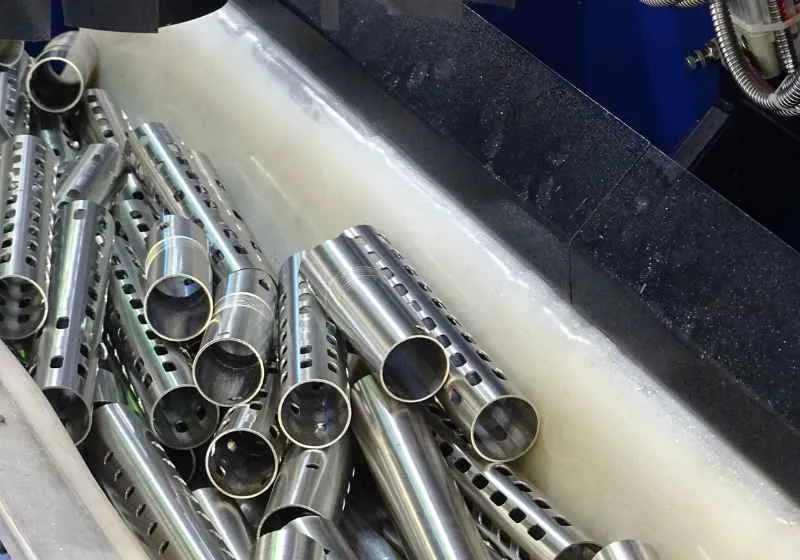
Holes, slots, windows, notches, cutouts, welding reference marks or assembly joints can all be done in the same cutting operation.
Instead of moving through different machines, the part comes out practically finished, reducing handling, errors and setup times.
Process comparison
|
Automatic cutting saw (RSA) |
Tube laser (HSG) |
|
Straight and mitre cutting |
External cutting + machining |
|
Immediate setup |
CAM programming |
|
Very low cost per cut |
Higher added value |
|
Ideal for simple parts |
Ideal for complex parts |
|
High productivity |
High flexibility |
Programming: the factor many comparisons overlook
Programming is one of the most important factors when evaluating a tube laser. If the customer has a 3D model in STEP, Parasolid or similar format, importing it into the CAM software is usually quick and generating the program takes little time. However, when only a 2D drawing, a PDF or even a physical part is available, the geometry needs to be rebuilt before the cutting paths can be defined.
That engineering time needs to be included in the economic analysis, especially for very short runs. That said, the initial programming cost is usually offset when it eliminates downstream operations such as drilling, machining, deburring, marking or weld preparation. What’s more, once created, the program can be reused every time the part is manufactured again.
Short, medium and long runs
For simple parts and very short runs, where there’s no CAD model and hardly any machining is involved, the cutting saw usually offers the most cost-effective solution.
As the geometry becomes more complex or the part will be manufactured repeatedly, the laser quickly starts to recover the time invested in programming.
On medium and long runs, especially with automatic loading and unloading, the laser’s automation keeps production running continuously with minimal operator involvement.
A practical example
A part made up of just four straight cuts is manufactured very efficiently with an automatic cutting saw.
However, if that same part includes six holes, two windows, assembly reference marks and joint geometries, the conventional process requires passing through several machines. With a tube laser, all those operations can be carried out in a single stage, simplifying the manufacturing flow and significantly cutting total production time.
Decision diagram
Do you only need to cut to length? → Automatic cutting saw (RSA)
Does the part include holes, slots or machining? → Consider a tube laser (HSG)
No STEP model available? → Factor in the CAM programming time.
Will the part be manufactured repeatedly? → The program is reused, improving cost-effectiveness.
The best investment isn’t necessarily the most advanced machine, but the one that reduces the total manufacturing cost of each part.
At CURVASER we analyse the full process before recommending a technology. That’s why we work with automatic cutting, laser cutting and special-application solutions, helping each customer choose the option that best fits their parts, production volume and growth goals.