Three-Roll Bending Machine: What It Is, How It Works and What It’s For
Three-Roll Bending Machine: What It Is, How It Works and What It’s For
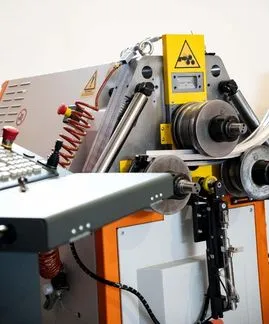
A three-roll bending machine is a machine that bends tubes and profiles by passing them between three rollers arranged in a triangle: two guide the material and one applies the pressure that creates the curve. It’s the go-to solution for achieving wide radii, arcs and circular shapes in a continuous, controlled way. In this guide we look at exactly what it is, how it works on the inside, and when it’s the right tool for the job.
At Curvaser we’ve been manufacturing, representing and repairing bending machinery for more than 35 years, so we know both its capabilities and its limits well. Let’s start with the basics.
What a three-roll bending machine is
It’s a type of profile bending machine that works through continuous bending. Instead of bending the material against a die in a single stroke, it feeds the material repeatedly between three rollers as they gradually close in, forming the part progressively until the target radius is reached.
That gradual process is its great strength. It allows long lengths to be bent with a uniform radius, the same shape to be repeated over and over, and profiles to be worked that would be impossible to bend in a single stroke without damaging them.
How it works on the inside
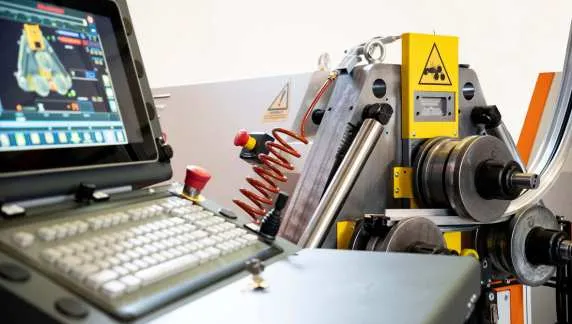
The three rollers are arranged in a pyramid or triangle shape. The most common configuration keeps two rollers on one side fixed in height, driving the material, while the third moves to impose the curve. On the most versatile machines, the rollers follow a planetary motion that widens the range of possible radii and shapes.
The process follows a clear sequence:
- The profile enters between the rollers, which grip it and pull it through.
- The pressure roller moves in by a calculated amount, forcing the material to take on a radius.
- The part moves back and forth between the rollers in successive passes.
- With each pass the roller moves a little closer, gradually closing the radius down to the target value.
On hydraulic machines, the roller movement is controlled via a screen and an encoder measures the actual degree of bending. On CNC versions, the whole cycle is programmed: the control manages positions, number of passes and speed to repeat the part without operator intervention. Having all three rollers driven matters, because it guarantees the torque needed to pull the profile through without slipping or marking it.
Two, three or four rollers: a quick note
Profile bending machines are built with two, three or four driven rollers. The three-roll type is the most common balance between versatility, finish quality and cost. Four-roll machines add end pre-bending that reduces waste, and two-roll machines with a counter-roller are simpler and more affordable. If you’re in the middle of a buying decision, we cover this in depth in our guide to choosing a profile bending machine.
What profiles and sections it can bend
One reason for its popularity is the range of material it can handle with the right tooling. By changing the forming rollers, the same machine can bend:
- Round, square and rectangular tube.
- Round, square and rectangular solid bar.
- Flat bar, both flatwise and edgewise.
- Structural profiles: angle, T, U and UPN channel, among others.
The roller set is therefore just as important as the machine itself: it defines which sections you can work and to what quality. That’s why it’s worth thinking about tooling from the very start, not as a last-minute accessory.
What it’s for: applications by sector
The three-roll bending machine is used in any sector that needs arcs, circles or curved metal shapes. Some common examples:
- Construction and architecture: curved beams for roofs, domes, arches, canopies and unique structures.
- Metalworking and locksmithing: railings, handrails, spiral staircases, curved doors and windows.
- Furniture and urban furniture: tables, chairs, streetlights, litter bins and design elements.
- Agriculture and industry: greenhouses, clamps, coils and heat exchangers.
Advantages over other bending methods
Compared with die bending, which excels at tight radii and precise angles, the three-roll bending machine shines at what it does best:
- Achieves wide radii and complete circular shapes with a uniform finish.
- Works long lengths continuously.
- Changes radius without needing a specific die for each one.
- Repeats the part reliably, especially on CNC versions.
Key concepts worth mastering
These three ideas help you get the most out of the machine and understand its limits. The first is the bending radius: the tighter you want it relative to the profile’s diameter, the more demanding the process and the greater the risk of deformation. The second is pre-bending, the step that forms the profile’s ends so they don’t stay straight; when the machine doesn’t pre-bend, those straight sections are scrapped, creating what’s known as dead ends or waste. The third is the typical bending defects, such as wrinkling on the inner face or ovalization of the section, which appear when the radius is too tight for the tube’s thickness or there’s insufficient internal support.
If your part needs very tight radii without losing its cross-section, you may not be looking for a roll bending machine but rather mandrel bending, a different process we cover in another blog article.
What Is a Mandrel Bending Machine and When Do You Need One?
Roll bending vs. die bending
It’s worth not confusing the two main bending methods, because they solve opposite needs. Die bending bends the tube around a fixed die and excels at tight radii, precise angles and parts like elbows or handles. Roll bending, the machine we’re covering here, works through progressive forming and shines at wide radii, long arcs and complete circles.
Put another way: if you picture the result as an elbow or a sharp angle, think die. If you picture it as a ring, a spiral or a gentle arc, think rollers. Many workshops end up with both processes because they cover different jobs.
Factors that influence the result
Getting a good curve isn’t just about moving the roller in. There are several factors the operator (or the CNC program) needs to take into account:
Number of passes. Closing the radius gradually, over several passes, gives a more uniform finish and reduces the risk of deforming the section. Forcing the radius in one go is the most common cause of marks and wrinkles.
Elastic recovery. All metal tends to spring back partially once the pressure is released. This effect, known as springback, means you need to bend a little more than planned for the part to end up at the exact radius, and it varies by material.
Lubrication and speed. Proper lubrication and the right feed speed prevent surface marks and reduce roller wear, especially on stainless steel and aluminium.
Tooling condition. The right roller for the section, in good condition, is what separates a clean curve from a defective part.
Maintenance and machine care
A roll bending machine has a long service life if it’s looked after. Basic maintenance means lubricating the points specified by the manufacturer, checking the condition of the rollers and shafts, and keeping the hydraulic system clean on machines that have one. On CNC versions, it’s also worth keeping the control up to date and backing up the programs for your regular parts. A good preventive maintenance plan avoids downtime and keeps the machine’s precision for years.
Common mistakes when roll bending
Some mistakes happen again and again across workshops, and they almost always come down to the same thing: rushing. It’s worth keeping them in mind to avoid them.
- Forcing the radius in too few passes, which causes wrinkles on the inner face and marks the surface.
- Using a roller that doesn’t match the section, which deforms or ovalizes the tube.
- Ignoring elastic recovery and ending up with a wider radius than intended.
- Bending thin-walled tube at a radius too tight for its thickness, when that job calls for mandrel bending instead.
The good news is that nearly all of these are fixed with the right tooling, progressive passes and a bit of method. A well-chosen machine and an operator who understands the process solve the vast majority of parts.
Frequently asked questions
What’s the smallest radius I can achieve with a three-roll bending machine?
It depends on the profile and its thickness, but rollers are designed for wide radii. For very tight radii relative to the diameter, another process is usually needed, such as mandrel bending.
Can the same machine bend both tube and flat bar?
Yes, as long as you have the right roller set for each section. Changing tooling is what lets you move from one geometry to another.
Is CNC control worth it?
If you repeat parts and want every one to come out the same without depending on operator skill, CNC saves setup time and improves repeatability. For one-off work, a well-adjusted hydraulic machine does the job.
Have a curved part in mind?
At Curvaser we help you choose the three-roll bending machine and roller set that fit your profile, your radius and your production volume, with new machines, used machines and custom tooling available.
Write to us at comercial@curvaser.com or call us on +34 976 651 333.