
What Is a Mandrel Bending Machine and When Do You Need One?
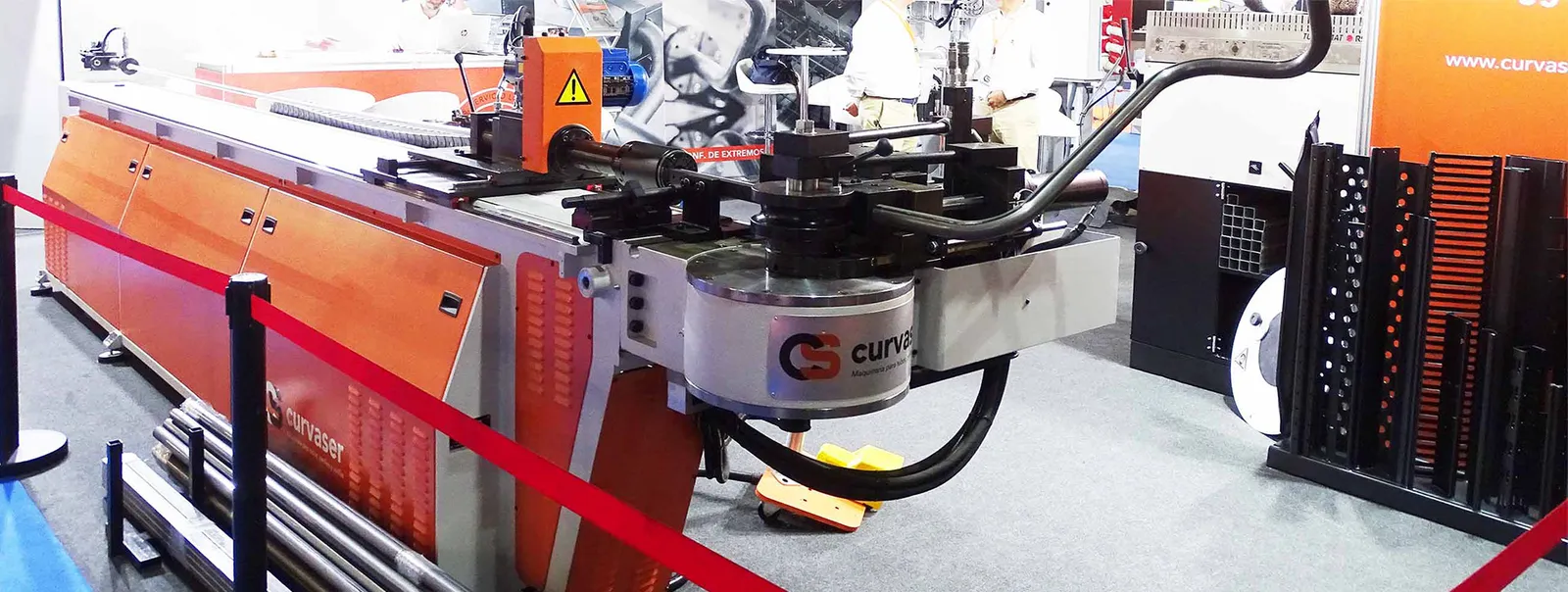
What Is a Mandrel Bending Machine and When Do You Need One?
People often talk about cold-bending a metal tube without thinking about how complex the job actually is, or about the fact that metal tends to resist deformation.
What happens when you bend a tube, which is basically a rolled and welded sheet?
All those tensions, stretches and compressions have to be absorbed within the molecules of the material being bent, and to make that happen you need to choose the right materials and the right tools.
Below, we look at the most fundamental tool for avoiding these deformations.
One of the most important decisions when bending tube is whether to use a mandrel bending machine. It’s not a minor question: it determines whether the finished part keeps its shape, its strength and its functionality.
The mandrel is often called the “core” or “soul” of the tube in traditional workshops, and that name is still used today. At CURVASER we use the technical term, but we also like calling the mandrel the tube’s “soul”, because during bending the mandrel literally becomes the tube’s inner support.
Although unsupported bending is often chosen for speed or cost, there are situations where using a mandrel is essential. In this article we explain clearly and directly what a mandrel bending machine is, how it works, how it differs from bending without a mandrel and, above all, when it’s mandatory depending on the type of tube, the wall thickness, the bending radius and the material. If you work with parts that require precision, this guide will give you the keys to avoiding mistakes and making better decisions.

How a mandrel bending machine works
The mandrel in a bending machine is a key component when the goal is to prevent internal deformation while bending tube. Its function is simple but critical: it’s inserted inside the tube, right at the point where the bend will be formed, to stop the internal walls from collapsing or wrinkling.
What exactly is the mandrel?
The mandrel is a rigid rod (sometimes flexible at its tip) that’s inserted inside the tube and advances as the tube is bent. Depending on the type of bending machine, the mandrel can be fixed or moving, and can have a ball-shaped, articulated or segmented tip to better follow the movement.
Components involved in mandrel bending
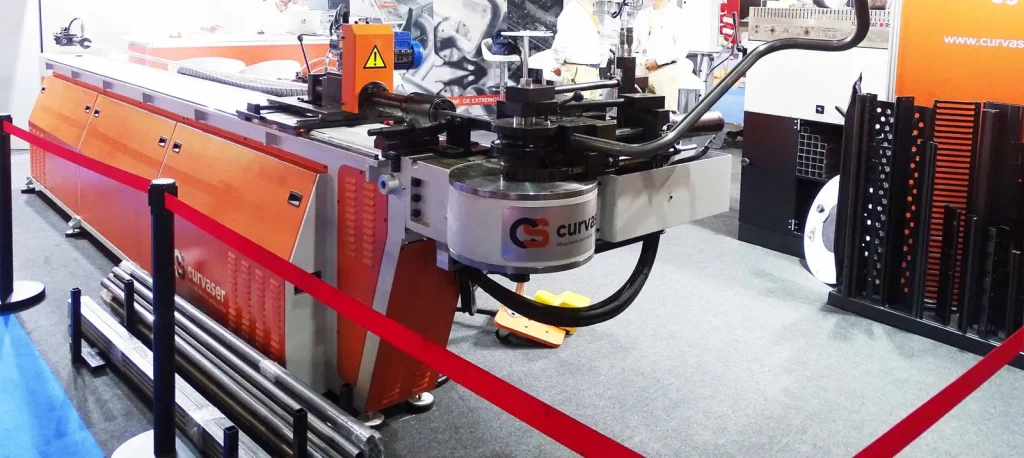
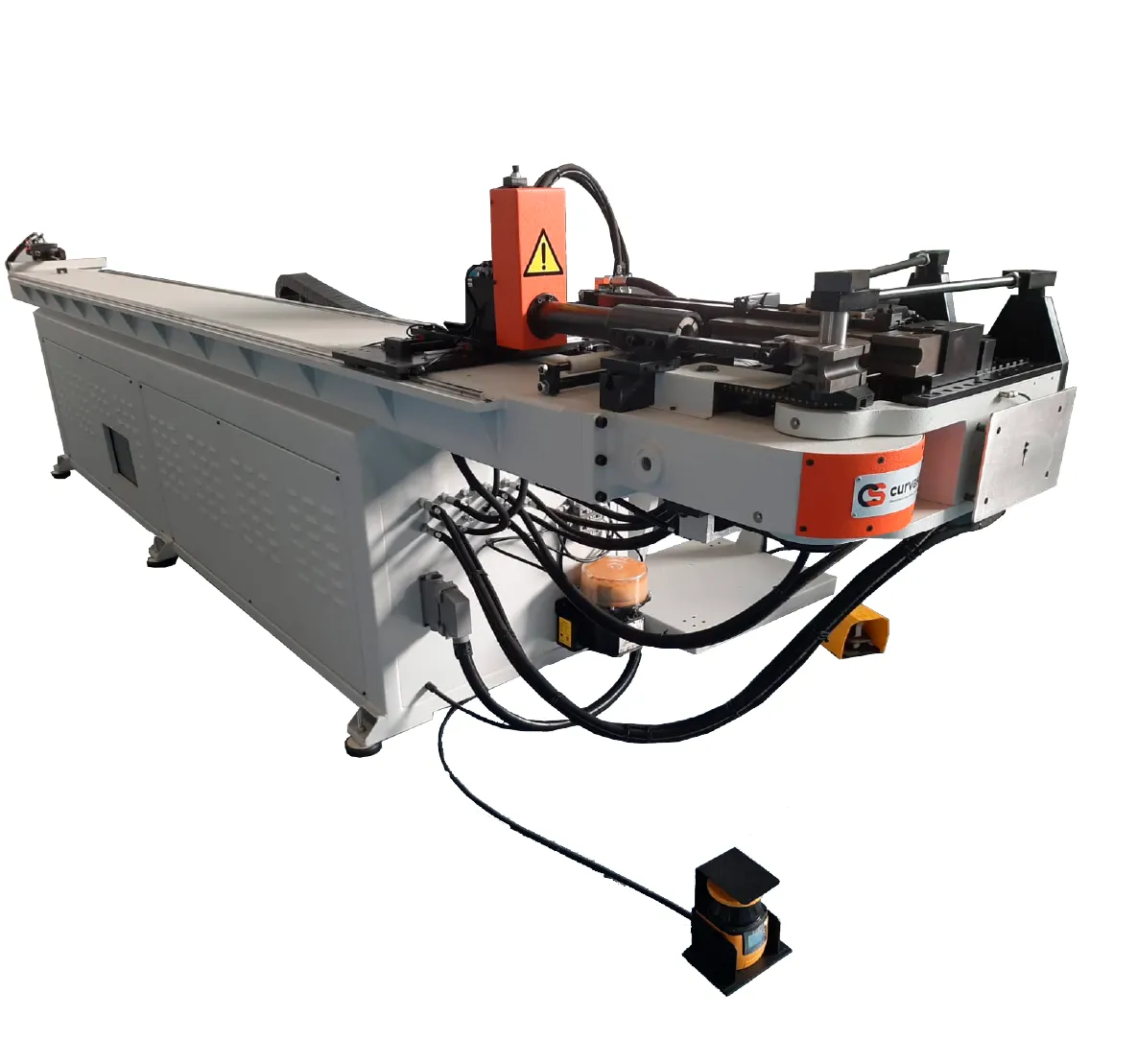
A mandrel bending machine typically includes these key elements:
- Mandrel: the internal piece that prevents deformation.
- Clamps: hold the tube in place to allow controlled movement.
- Bending roller or die: sets the desired radius.
- Feed carriage: moves the tube through the bend with precision.
This type of bending requires perfect alignment between the mandrel and the tube, and takes longer to set up. But the result is a tube bent with precision, with no internal collapse and a uniform cross-section.
Why is the mandrel so important?
When a tube is bent, the outer wall stretches while the inner wall is compressed. Without support inside the tube, the inner area can wrinkle or collapse, especially if the wall is thin or the radius is small. The mandrel acts as a containment barrier: it forces the tube to stretch where it should, keeping its shape and strength intact.
Mandrel bending vs. bending without a mandrel
At first glance, bending with or without a mandrel might seem like a minor detail. In practice, though, the choice directly affects the quality of the result, the tube’s final geometry and its structural function. Here we compare both methods so you know when each one makes sense.
Technical differences in the final result
Bending without a mandrel is faster and cheaper, ideal for large-radius parts or thick-walled tube. But it offers no control over what happens inside the tube during bending. This can lead to:
- Internal wrinkles: in the compressed area of the radius.
- Ovalization of the cross-section (the tube is no longer perfectly round).
- Reduced flow area in ducts and pipework.
- Loss of structural strength: depending on the material.
Mandrel bending, on the other hand, allows you to:
- Keep the tube’s original circular profile.
- Avoid critical deformation
- Achieve much tighter bending radii without compromising the part.
- Meet technical standards in demanding sectors such as aerospace, automotive or hydraulics.
Advantages of mandrel bending
Despite its added complexity and higher operating cost, mandrel bending offers key technical advantages:
- Greater dimensional precision and repeatability.
- Better internal surface finish.
- The ability to work thin-walled tube without collapse.
- Applicable to delicate materials such as copper or thin stainless steel.
- It’s the only reliable method for short radii on thin tube.
That’s why, when result quality is a priority or you’re working with tube that could easily collapse, mandrel bending isn’t just recommended: it’s essential.
When a mandrel is mandatory for bending tube
The decision to use a mandrel or not shouldn’t be based on intuition or past experience alone. There are objective technical criteria that indicate when bending without a mandrel is viable and when this internal support is necessary. The three determining factors are: tube thickness, the material and the bending radius.
Influence of tube thickness
The thinner a tube is, the greater the risk of collapse or wrinkling during bending. As a general guideline:
- If the thickness is less than 10% of the outer diameter, using a mandrel is mandatory.
- On tube with a diameter-to-thickness ratio above 10:1, bending without a mandrel usually causes ovalization and internal failure.
- Thick-walled tube (ratio of 5:1 or lower), on the other hand, can usually be bent without a mandrel, especially if the radius isn’t too tight.
Example:
A 50 mm diameter tube with 1 mm wall thickness has a 50:1 ratio → it must be bent with a mandrel to avoid collapse.
Material matters too: steel, stainless, aluminium, copper
How the material behaves under deformation is key. Some materials tolerate the internal compression of the radius better, while others are more prone to wrinkling or cracking.
- Aluminium and copper: very ductile but also soft → almost always require a mandrel at tight radii.
- Stainless steel: sensitive to deformation → a mandrel is advisable to keep the internal shape.
- Carbon steel: tolerates more aggressive bending, but thickness still dictates the outcome.
- Titanium, brass, exotic materials: unpredictable behaviour without a mandrel, especially on critical parts.
The bending radius as a determining factor
The bending radius defines how tight the curve will be. And the tighter the radius, the greater the internal deformation and the complexity of the job:
- Radii smaller than 3 times the tube diameter usually require a mandrel without exception.
- Radii between 3 and 5 times the diameter depend on the thickness and material.
- Radii larger than 5 times the diameter can often be bent without a mandrel if the thickness allows it.
Quick-reference table for deciding whether to use a mandrel:
| Diameter | Thickness | Material | Radius | Mandrel required? |
| 30 mm | 1 mm | Stainless | 60 mm | Yes |
| 50 mm | 2 mm | Aluminium | 100 mm | Yes |
| 40 mm | 3 mm | Carbon steel | 200 mm | No |
| 25 mm | 1.5 mm | Copper | 50 mm | Yes |
This table is only a guide: at Curvaser we analyse every part in detail to define the most suitable method.
What happens if you skip the mandrel when you shouldn’t
Skipping the mandrel on a bend that requires it doesn’t just affect the tube’s appearance — it can seriously compromise its function and durability. These are the most common problems that show up when trying to bend a tube without a mandrel when it shouldn’t:
- Internal wrinkles: folds form in the compressed area of the radius, weakening the tube’s structure.
- Partial or total collapse: the tube can deform to the point of closing internally, blocking fluid flow or reducing its strength.
- Severe ovalization: the circular section becomes oval, affecting assembly precision or sealing if the tube connects to other parts.
- Cracking or fracture: on less ductile materials, the lack of internal support can cause visible fissures or internal microcracks.
- Part rejection: in regulated sectors (automotive, aerospace, hydraulics), a part bent without a mandrel that’s out of tolerance will be automatically rejected.
Beyond the technical impact, this means lost time, materials and money. In some cases, the fault isn’t spotted until the part is assembled, adding even more cost.
That’s why at Curvaser we take a preventive approach: if the technical analysis shows a mandrel is needed, we build it into the process from the very start. That’s how we guarantee the final quality and avoid costly mistakes.
What Curvaser brings to precision mandrel bending
In industrial bending, having the right machines isn’t enough. It takes technical knowledge, accumulated experience and precision in every detail. At Curvaser we’ve spent more than 35 years mandrel-bending tube for sectors where there’s zero margin for error: automotive, hydraulics, heavy machinery, renewable energy and precision boilermaking.
Over 35 years of mandrel bending on demanding parts
We know when a part can be bent without a mandrel and when there’s no alternative. Our experience lets us anticipate potential faults before they happen, proposing the best solutions from design through to execution. We’ve worked with every kind of material: stainless steel, aluminium, carbon steel, copper and special alloys, always adapting the method to the technical requirement.
On every project, we analyse:
- Tube geometry and bending radius
- Thickness and type of material
- Required dimensional tolerances
- The need to avoid ovalization, wrinkles or collapse
- Compatibility with other process stages (welding, machining, assembly)
Machinery and skilled staff for error-free bending
We have high-performance CNC bending machines equipped with rigid and articulated mandrel systems, letting us achieve tight radii with maximum precision. Our technical team is trained to help you fine-tune bending parameters and oversee every stage of the process.
The result: perfect bends, with no internal deformation, exact tolerances and professional finishes.
How to know if your project needs a mandrel bending machine
If you’re designing a bent part or need to produce a tube without deformation, it’s important to assess from the start whether the process will require a mandrel. This technical decision doesn’t just affect quality — it also affects the type of machinery, the cost of the process and production times.
Here’s a quick checklist to help you identify whether your project needs a mandrel bending machine:
- Is the tube wall thin relative to its diameter?
- Is the bending radius small, less than 3 times the tube diameter?
- Is the material soft or prone to wrinkling (aluminium, copper, stainless steel)?
- Do you need to keep the circular cross-section without ovalization?
- Is the tube part of a hydraulic or pneumatic system with a critical flow area?
- Does the part need to meet strict quality standards or pass dimensional inspection?
If you answered yes to one or more of these questions, it’s very likely that using a mandrel is mandatory or highly recommended.
At Curvaser we help you make the right decision from the outset. We analyse your drawing, your requirements and how the material behaves to offer you the best technical solution, with no guesswork and a guaranteed result.


